
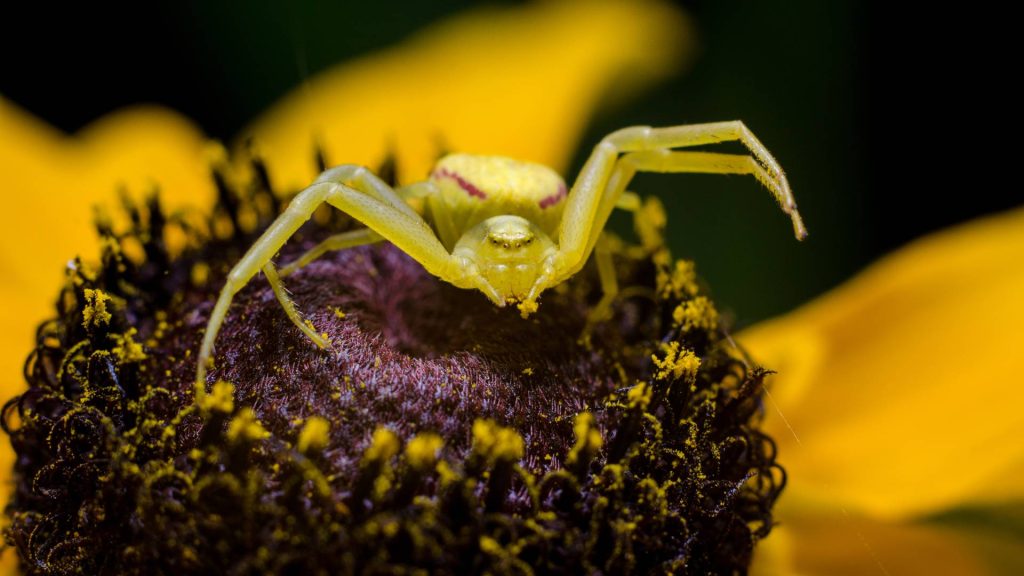
In the diverse ecosystems of Ecuador, from cloud forests to urban gardens, there is a fascinating and little-known creature: the crab spider. Its common name comes from its peculiar way of moving sideways, very similar to a crab, and its appearance, which often goes unnoticed among flowers and leaves. This spider does not build cobwebs to catch its prey but specializes in stealth hunting, relying on its camouflage and speed.
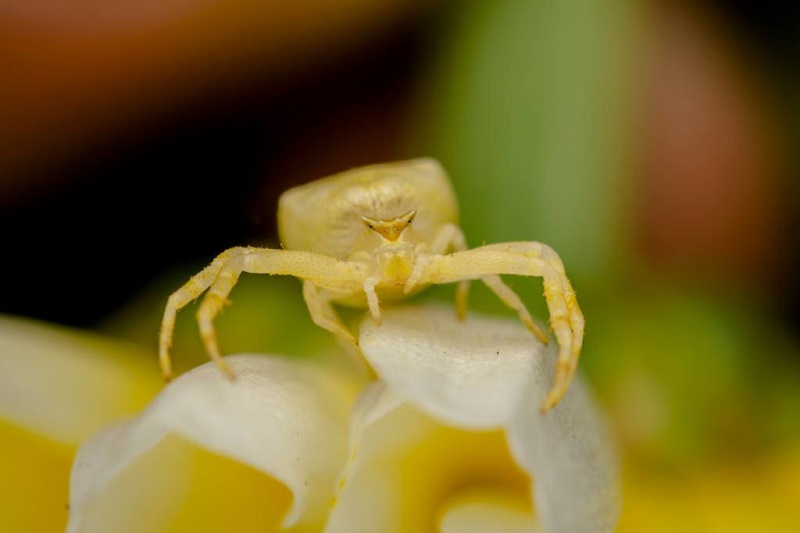
Belonging to the Thomisidae family, the crab spider has a distinctive morphology: its body is flattened and its front legs are longer and stronger, allowing it to catch insects with precision. Many species can slightly change color to better mimic their background, especially flowers where they often hide while waiting for prey.
In Ecuador, it can be found in various regions, including the tropical Amazon, the mountainous Andes, and the coast. Its presence is more common in gardens and flowering plants, where it preys on bees, butterflies, and other pollinators. Despite this, it poses no danger to humans, as its venom is not harmful to us and it rarely feels threatened enough to bite.
The crab spider plays an important role in the natural control of insects and, therefore, in ecological balance. By feeding on other arthropods, it helps regulate insect populations in its environment. Additionally, its relationship with flowers demonstrates a curious balance: although it preys on pollinating insects, it also keeps pest populations in check that could harm plants.
The behavior of the crab spider highlights the wonders of evolution and animal adaptation. In a world where many species rely on webs to catch food, this arachnid has developed a different and effective strategy based on immobility, patience, and camouflage.
The crab spider is a fascinating example of Ecuadorian biodiversity. Though small and discreet, it plays a key role in its ecosystem. Observing it carefully can teach us a lot about the complexities of nature and how even the tiniest creatures can be masters in the art of survival.
