
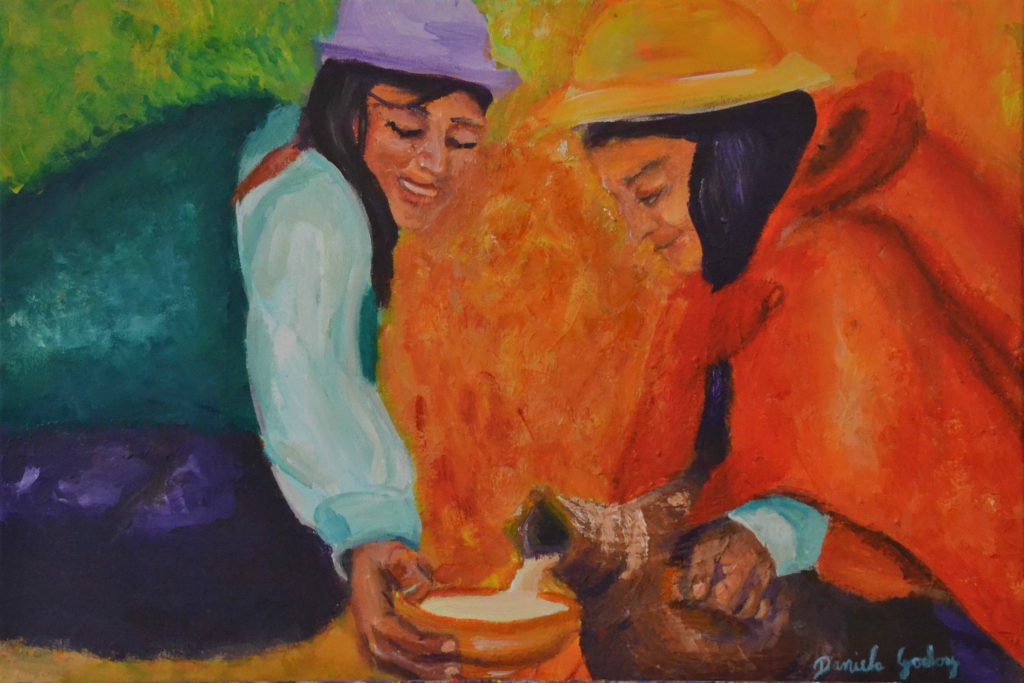
Contemporary Indigenous art in Ecuador is much more than an aesthetic expression; it is a profound manifestation of identity, memory, and resistance. Through painting, sculpture, ceramics, textiles, and urban art, Indigenous peoples are reinterpreting their traditions to engage with the modern world, without losing sight of their ancestral roots.
The most fascinating aspect of contemporary Indigenous art is its ability to combine traditional elements—cosmogonic symbols, artisanal techniques, and natural materials—with contemporary visual languages. This creates a bridge between the ancestral and the modern, allowing art to act as a living narrative of the communities' history and culture.
Artists such as Olmedo Quilapán, Ñaupany Puma, Ruth Montaño, and many others have used their works to speak about territory, spirituality, connection with nature, and the defense of Indigenous rights. Their creations are exhibited not only in galleries but also in public spaces, cultural fairs, and community centers.
Contemporary Indigenous art also becomes a form of resistance against cultural loss, colonization, and exclusion. In every stroke and every weave, a struggle to make visible languages, knowledge, spiritualities, and ways of life that have been historically marginalized is evident.
Furthermore, this art challenges the stereotypes that often reduce Indigenous peoples to a folkloric or static vision. On the contrary, it demonstrates that these cultures are alive, constantly changing, and fully embedded in current social, political, and ecological debates.
Ecuador is a plurinational and multicultural country, and Indigenous art is a reflection of that richness. The diversity of styles, techniques, and themes reflect the variety of peoples and nationalities: Kichwa, Shuar, Achuar, Cofán, Waorani, among others. Each community contributes its worldview, its aesthetics, and its wisdom.
This artistic expression not only enriches the country's cultural landscape but also invites us to rethink history from other voices and other ways of seeing the world. Visiting an exhibition, acquiring a work, or participating in a contemporary Indigenous art workshop is also an act of recognition and appreciation of diversity.
Contemporary Indigenous art in Ecuador is not just art. It is history, identity, protest, and spirituality. It is a glimpse into the deep soul of a country that, through its indigenous peoples, keeps alive the collective memory and the hope for a more just future in harmony with nature.
